Blogs / Latest Blogs / Certified ...
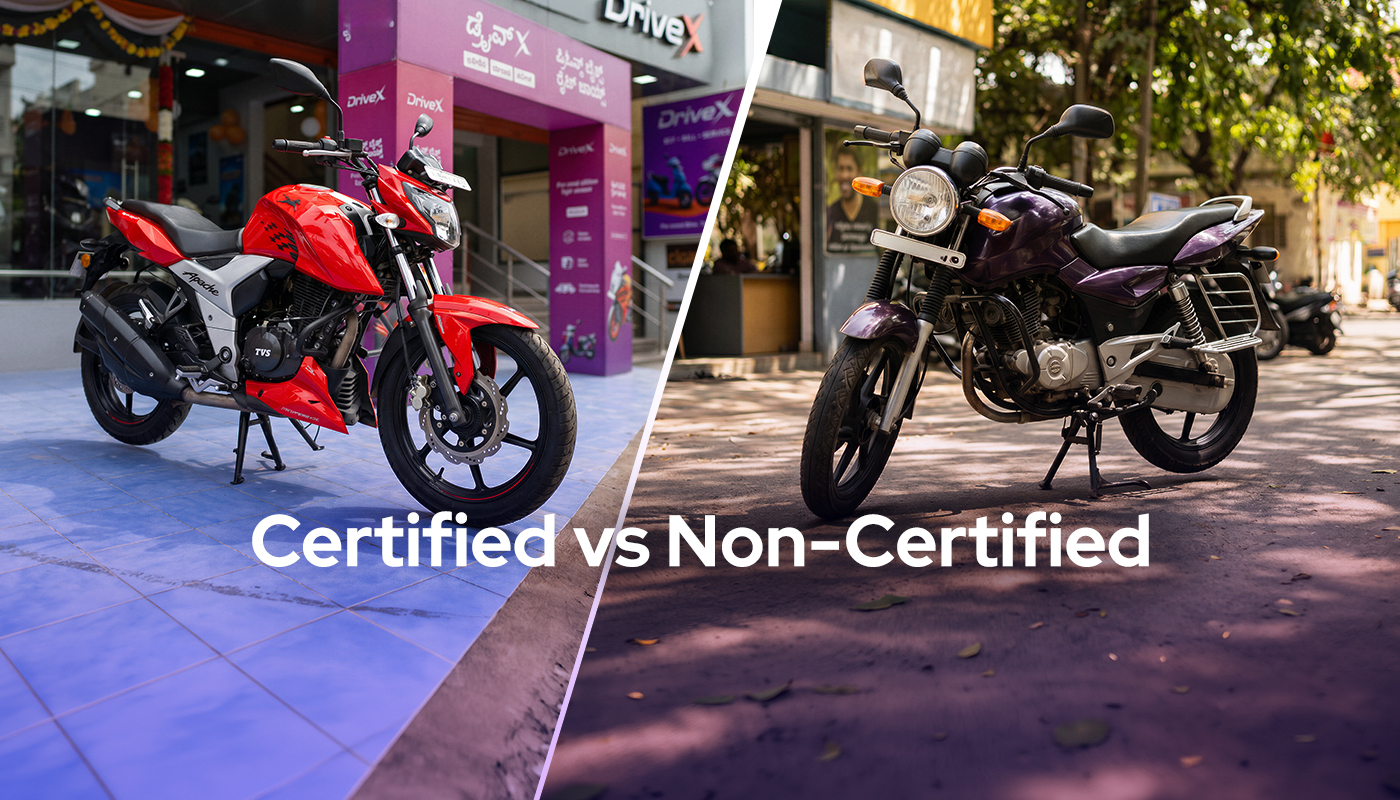
Certified vs Non-Certified Pre Owned Bikes: What Should You Choose?
Nikhil Murali
20 Jul 2026 • 2 mins read
A used bike can look clean, start without hesitation and still leave an important question unanswered: what has actually been checked?
This is where the difference between certified and non-certified used bikes becomes important. The distinction is not simply about where the vehicle is sold. It is about how much information, verification and accountability sit behind the purchase.
For a buyer comparing a 2nd hand two wheeler, the real decision is not “new-looking versus old-looking.” It is “known condition versus uncertain condition.”
What is a certified pre-owned bike?
A certified second-hand bike is a pre-owned vehicle that has gone through a defined evaluation process before being offered for sale. The process may include mechanical checks, documentation verification, road testing, refurbishment and a review of the bike’s overall condition.
However, the word “certified” should not be accepted without questions.
Buyers should ask:
- What exactly was inspected?
- Who conducted the inspection?
- Is there a written vehicle report?
- Were identified issues repaired or only disclosed?
- What documentation was verified?
- What support is available after purchase?
A useful certification process gives the buyer more than reassurance. It gives them evidence.
What is a non-certified used bike?
A non-certified bike may be sold directly by an owner, through a local intermediary or on a listing platform without a standard inspection and refurbishment process.
This does not automatically mean the vehicle is poor. A well-maintained owner-sold bike can be a good purchase. The difficulty is that the buyer often has to independently establish its condition, history, documentation and fair value.
Certified vs non-certified: the practical differences
1. Inspection consistency - A certified process usually follows a defined checklist. In a private transaction, the quality of inspection depends on the buyer, seller or mechanic involved.
2. Condition visibility - Certified second hand bikes should provide clearer information about what was checked and what was repaired. With a non-certified vehicle, buyers may need to discover this themselves.
3. Documentation review - A structured seller is more likely to verify ownership records and supporting documents before the transaction. In an unstructured purchase, the buyer must take greater responsibility for checking RC details, insurance, hypothecation status and transfer documents.
4. Refurbishment - Some certified vehicles are refurbished before sale. A non-certified bike is often sold in its current condition. Refurbishment standards and scope must be confirmed.
5. Accountability - Certification is most meaningful when a named organisation owns the process. When something is unclear, the buyer should know whom to approach.
Pros of a certified used bike
- Greater visibility into vehicle condition.
- A more consistent inspection process.
- Reduced dependence on appearance and seller assurances.
- Better documentation discipline.
- A more organised buying experience.
Possible limitations
- Certified bikes may be priced differently from an owner-listed vehicle because evaluation, refurbishment and process support may be included.
- Certification standards vary between companies.
- Buyers should still take a test ride and read every document carefully.
Pros of a non-certified used bike
- A wider range of direct-owner options.
- Greater room for individual negotiation in some transactions.
- Potential access to detailed ownership history when the seller has maintained records.
Possible limitations
- Inspection quality may be inconsistent.
- Repairs may become the buyer’s responsibility immediately.
- Documentation and RC-transfer follow-up may require more personal effort.
- It can be difficult to compare two vehicles fairly without standardised reports.
How the DriveX approach reduces uncertainty
DriveX positions DriveX Assured around a more organised way of evaluating pre-owned two-wheelers. Instead of asking the customer to judge a bike only from a listing or a short ride, the intended approach is to combine inspection, quality checks, documentation review and a physical customer experience.
The exact DriveX Assured inspection stages, report format, refurbishment scope, warranty options and post-purchase support must be confirmed before publication.
A buyer’s checklist before choosing any used bike
1. Match the chassis and engine numbers with the RC.
2. Check whether a loan or hypothecation is still recorded.
3. Review tyre, brake, suspension, battery and fluid condition.
4. Ask for service and repair records.
5. Take a meaningful test ride, not only a short loop.
6. Ask what has been repaired or replaced.
7. Understand the RC-transfer responsibility and process.
8. Get every promise in writing.
The right choice is the one you can understand
A certified bike is not automatically perfect, and a non-certified bike is not automatically unreliable. The difference lies in how much uncertainty the process removes.
When the inspection is structured, the documentation is clear and the vehicle’s condition is explained honestly, you are not buying on hope. You are making a decision with more confidence.